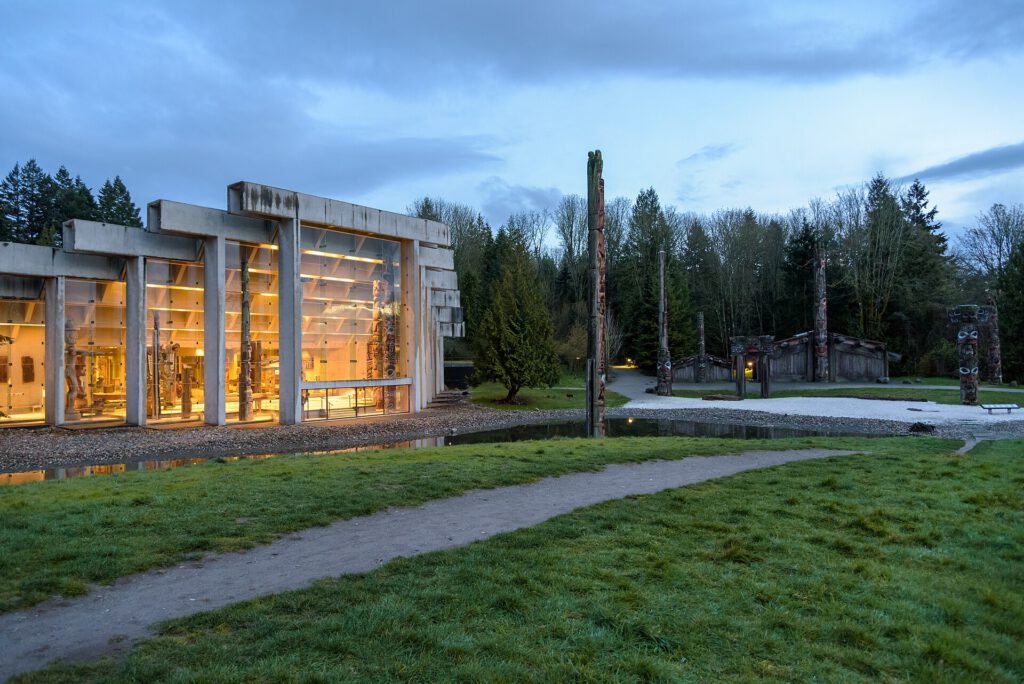
Ayana V. Jackson went more than 90 feet underwater with a camera to film a kingdom that, in the story she is telling, belongs to the people the slave trade threw into the Atlantic. The show she built from it, From the Deep: In the Wake of Drexciya, opens today at the Museum of Anthropology at the University of British Columbia in Vancouver. It is the Canadian premiere.
The idea is not hers alone. Drexciya, the Detroit techno duo of James Stinson and Gerald Donald, spent the 1990s imagining an underwater nation populated by the descendants of pregnant African women who were thrown overboard, or who jumped, during the Middle Passage. Black Detroit turned a grave into a country. Jackson, a photographer who lives between Brooklyn and Johannesburg, takes that country seriously enough to go and film it.
The museum calls the result “a feminist, Pan-African aquatopia inhabited by water spirits from African and Afro-Atlantic traditions.” It is her first solo exhibition, and it marks a move from still photography into immersive video, animation and installation. According to the tour’s organizer, International Arts & Artists, she worked with designers and creatives across Africa and its diaspora, and the show holds about 33 works: 17 photographs, seven video and stop-motion installations, and five costumes on mannequins, plus costume components.
The Smithsonian’s National Museum of African Art first presented the exhibition in Washington, where Karen Milbourne curated it. Vancouver is the first stop on its tour, and the booked dates after that read like a map of Black American memory: the Charles H. Wright Museum of African American History in Detroit, Drexciya’s home city, from April to August 2027, then the Spelman College Museum of Fine Art in Atlanta from September to December.
For Black readers in Canada, the draw is plain. The Atlantic is the ancestral crossing for African Nova Scotians, for Caribbean families in Toronto and Montreal, and for Black Canadians whose people arrived by other routes but carry the same history. Most museums that touch the Middle Passage show it as loss. Jackson’s show asks what the dead might have built, and a Canadian gallery with a major audience is giving that question a long run in the Audain Gallery.
That is the right use of a public museum’s biggest room. A show that treats Black ancestry as a source of invention, not only of grief, should have a long run in Canada, and it does.
The opening celebration is tonight at 7 p.m. and is free. Jackson leads tours on Nov. 21, included with admission, and the curator tours follow on Dec. 3, Jan. 14 and Feb. 25.

Have your say