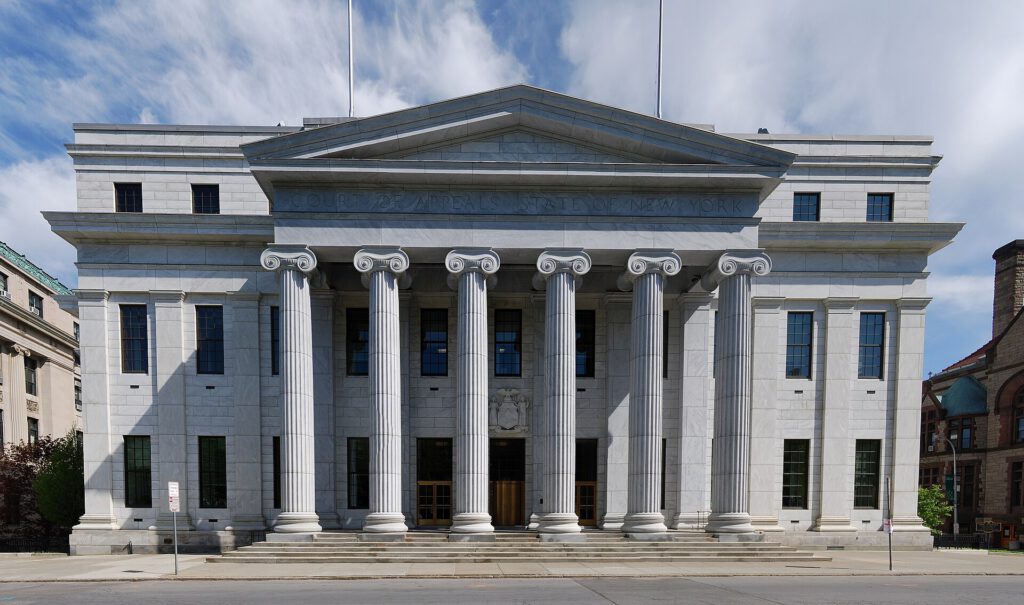
New York’s highest court ruled Monday that Meta, Reddit and Google do not have to answer in court for the 2022 racist massacre at a Buffalo supermarket, in which ten people were killed. The Court of Appeals split 4 to 3, so the families who sued lost by a single vote.
The attack on May 14, 2022 targeted the Tops market on Jefferson Avenue, a grocery store in a Black neighborhood of Buffalo. The ten people killed were Black. The gunman, Payton Gendron, was 18 and later convicted. Survivors and relatives of the dead argued that the platforms he used built products meant to addict young users, and that their algorithms fed him the white supremacist content that radicalized him. Four suits were consolidated against the companies, and the court affirmed their dismissal.
What the majority said
The majority did not rule on whether the platforms’ content is protected. It ruled that the families had not connected the products to the killings. The plaintiffs, the court said, “failed to adequately allege that the defendants’ platforms’ features caused their grave injuries.” The shooter’s planned violence was “so extraordinary as to sever the causal chain as a matter of law,” the majority held.
The court also left open the question that the companies have relied on in lower courts: whether Section 230 of the Communications Decency Act, the federal law that shields platforms from liability for what users post, protects them here. An intermediate appeals court had dismissed the suits last year by a 3 to 2 vote, saying federal law gave the companies immunity and that recommendation algorithms did not strip them of their status as publishers. The high court did not adopt that reasoning.
A concurrence by Judge Halligan went further in a direction that matters for future cases. As Reason’s Volokh Conspiracy reported, she wrote that addiction claims might succeed where a platform harms its own users’ mental health, and suggested that content-recommendation algorithms may deserve closer scrutiny than traditional publishing. This case differed, she wrote, because the platforms allegedly harmed the shooter, who then harmed others.
The dissent
Three judges would have let the cases go forward. They argued that the companies designed addictive algorithms while knowing the harm to teenagers, and pointed to the shooter’s own writings, in which he described becoming addicted to social media and isolating himself before the attack.
That is the part of the ruling Black readers should sit with. The families did not ask a court to punish speech. They asked a jury to decide whether companies that profit from time spent on their feeds bear any responsibility when those feeds deliver a young man toward a plan to murder Black strangers in a grocery store. Four judges said no, without a trial and without discovery into what the platforms knew.
The families’ lawyers have said before that the fight would not end at the lower court, and the case against the seller of the shooter’s body armor has moved on a separate track. But Monday’s decision closes the courthouse door on the companies that built the pipeline. Congress could reopen it by rewriting Section 230 so that algorithmic amplification of racist violence carries a price. Until it does, the cost of that design falls on the neighborhoods that live with its results.
Have your say