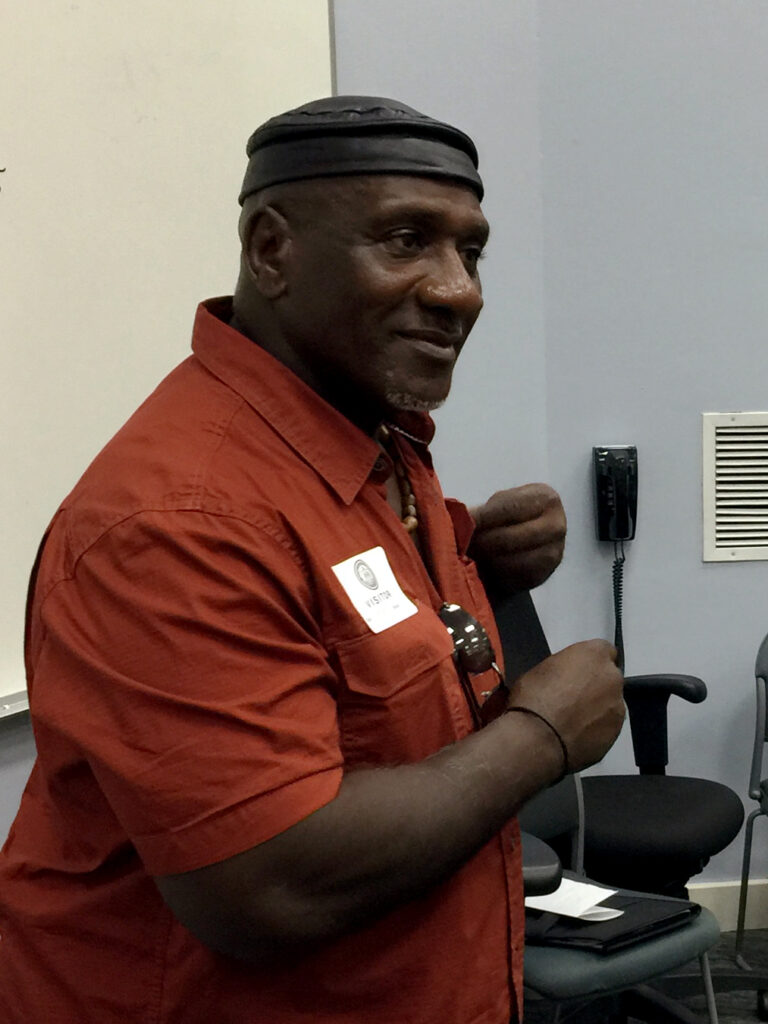
Gary Tyler was 16 when he was arrested in St. Charles Parish, Louisiana,. In 1975 an all-white jury convicted him of first-degree murder and he was sent to death row. He walked out of Angola, the state penitentiary, on April 29, 2016, at 57. This month the Grand Rapids Art Museum opened the first solo museum exhibition of the quilts he made inside.
“Gary Tyler: Rebirth” opened Oct. 3 and runs through Jan. 3, 2027, in the museum’s second-floor changing galleries. The textile works, quilted and appliquéd, take up hope, resilience and mass incarceration. Titles on the museum’s page include Hope, Captivity, 1973 and Indignity, 2017.
Tyler has said fabric gave him something prison rarely allowed. “Doing textile work gives me an opportunity to be able to utilize fabric in a most creative way that I never thought really existed,” he says in the museum’s artist statement. “It’s something that I feel that’s empowering.”
He learned to quilt through a prison charity that raised money so inmates’ families could visit. He told Hyperallergic that “my mother and grandmother both used to sew, and it made me feel good to be connected to them like that.” His quilting also supported the Angola Prison Hospice program, which cares for dying prisoners.
A case that never settled
His arrest followed a 1974 school bus incident in St. Charles Parish in which a white boy was killed. In 1980 the Fifth Circuit Court of Appeals found Tyler’s trial fundamentally unfair and reversed the conviction. The ruling was overturned in 1981 and he received a 41-year sentence. He was released in 2016 after entering a plea. He received no compensation and no acknowledgment of wrongdoing from the state, according to Hyperallergic.
The Grand Rapids show is not his first. “We are the Willing,” curated by Allison Glenn at Library Street Collective in Detroit, opened in 2023 and featured quilted self-portraits from his years inside, along with butterflies and birds that mark the passage from confinement to freedom. Tyler now works as lead outreach coordinator for Safe Place for Youth, which serves unhoused young people, and keeps a studio practice.
The exhibition closes Jan. 3.
Have your say