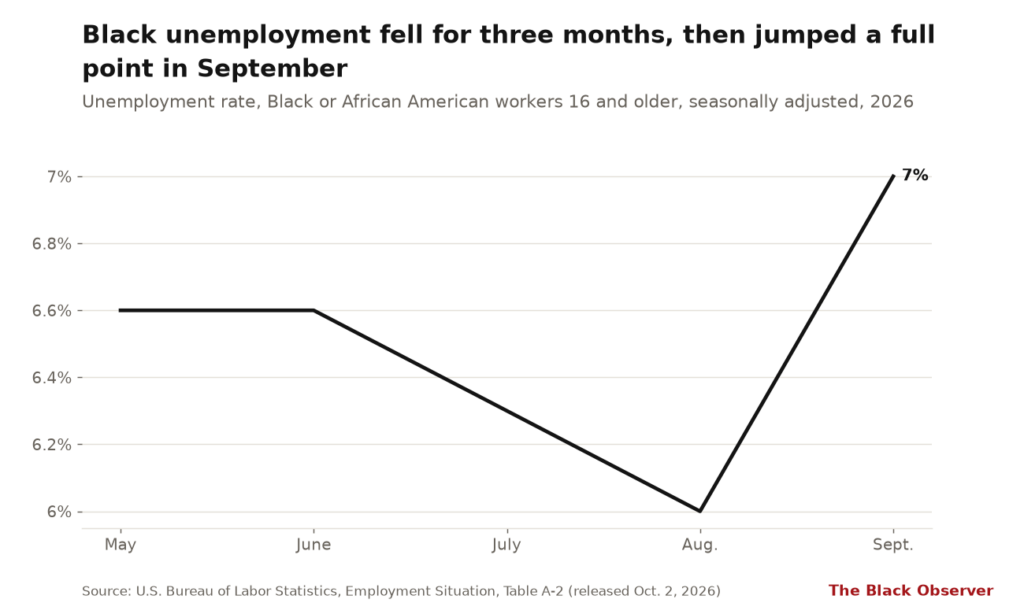
The Black unemployment rate rose from 6.0% in August to 7.0% in September, while the white rate held at 3.6%, according to the Bureau of Labor Statistics jobs report released Oct. 2. Black workers were unemployed at nearly twice the white rate. It was the largest one-month rise for Black workers in the series since the spring of 2020, the first weeks of the pandemic, as several outlets including TheGrio reported.
The rest of the labor market barely registered the month. The overall unemployment rate stayed at 4.2%. The Asian rate was 2.9%, the Hispanic rate 4.7%. Employers added only 29,000 jobs nationwide. When hiring is that thin, the workers who are let go first, or hired last, show it first.
One month is not a trend
The Black unemployment rate is one of the most volatile numbers the government publishes. It comes from the household survey, a sample of homes, and the Black portion of that sample is small. Economists who follow it routinely warn against reading a single month, and several did after this report. Both readings are fair: the jump is real in the data, and the data move a lot.
The recent path shows why. In the same series the Black rate was 6.6% in May and June, 6.3% in July and 6.0% in August, a steady slide. A year earlier, in September 2025, it stood at 7.6%. So September 2026 is a reversal of a four-month improvement, not a record. Black unemployment is still below where it was a year ago.
The split inside the number is also worth reading. Table A-2 puts the rate for Black women 20 and older at 6.8% and for Black men 20 and older at 6.0%. Women carried more of the September rise.
What the improvement was made of
Part of the August improvement may not have been good news. The BLS also tracks labor force participation, the share of Black adults working or looking for work. It fell from 63.0% in September 2025 to 61.3% in July 2026 and was 61.6% in August. When people stop looking, they stop being counted as unemployed.
That is the reading Cantrell Dumas, who studies Black workers, gave Amsterdam News after the August report: “one of the reasons the unemployment rate could be going down is that a lot of Black people are not looking for jobs anymore.”
September cuts the other way. Participation climbed to 62.5%, which means more Black workers were back in the market looking for work, and not all of them found it. That alone can push the rate up without a single new layoff.
Why it matters beyond the month
The gap in September, 7.0% against 3.6%, is close to a two-to-one ratio. A year earlier the Black rate was 7.6%, so the disparity is not new. What changes month to month is how many Black workers are caught in it: the Black rate moves by whole points in a survey where the white rate moves by tenths.
Amsterdam News tied the August gains to a few sectors: 42,000 jobs in local government education, 13,000 in health care and 22,000 in construction, industries that employ many Black workers. If hiring in those fields cools, the cushion thins quickly, and with payrolls growing by only 29,000 jobs in September, it is already thin.
The next test comes with the October jobs report, due in early November. A second month at or near 7% would turn a spike into a direction. A return toward 6% would suggest September was the survey’s noise. Either way, the BLS series will show it before most forecasts do.

Have your say