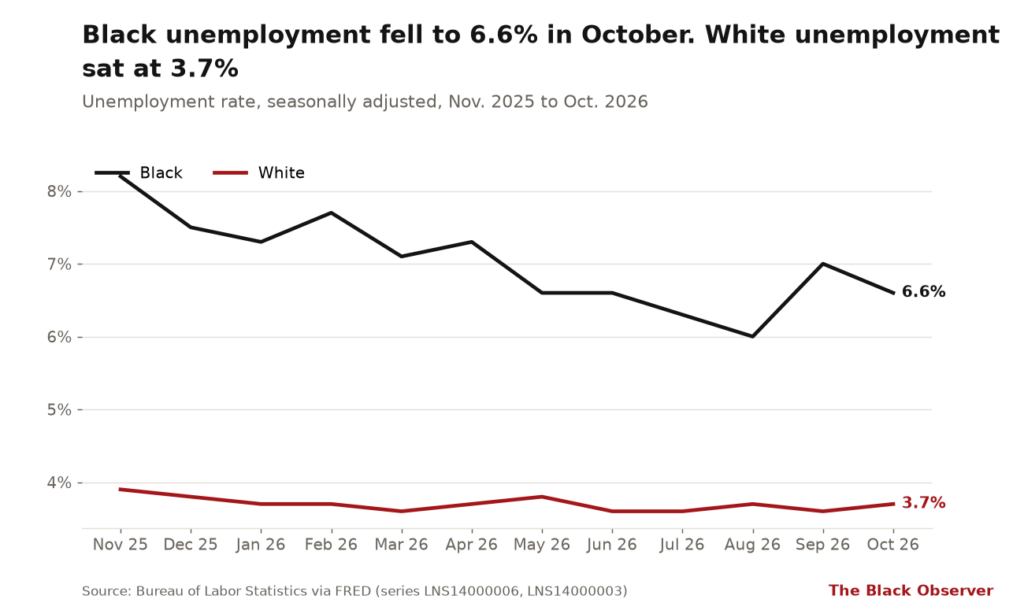
In October, 6.6% of Black workers in the labor force were out of work and looking for a job. For white workers it was 3.7%. That is a gap of 2.9 percentage points, and it means a Black worker was nearly twice as likely as a white worker to be unemployed.
The Bureau of Labor Statistics, in its October employment report released Nov. 6, described the month as one of little change. Employers added 165,000 jobs and the national unemployment rate held at 4.1%. Black workers were 2.5 points above that national figure. The Hispanic rate was 4.7% and the Asian rate 2.8%. The rate for adult women overall was 3.6%, while for Black women 20 and older it was 6.5%.
A steady report is not a steady experience for everyone in it.
A year of improvement that left the gap standing
The Black unemployment rate has come down. It was 8.2% in November 2025, according to the BLS series that the Federal Reserve Bank of St. Louis publishes through FRED. It was 7.5% in December. In 2026 it ranged from a high of 7.7% in February to a low of 6.0% in August, before jumping to 7.0% in September and settling back to 6.6% in October.
The white rate barely moved. It stayed between 3.6% and 3.9% in every month from November through October, according to the matching white series. The result is that the gap has shrunk from 4.3 points in November to 2.9 in October. That is real progress, and the paper counts it as such. It is also the gap that remains after a year in which the Black rate never once fell below 6%.
No figure for October 2025 was published, so the chart below begins in November.
What one month can and cannot say
A fair reading has limits. Monthly figures for any single group come from a survey sample, and the Black rate bounces more than the white rate does. A drop from 7.0% to 6.6% in one month is not a trend, just as the jump from 6.0% to 7.0% in September was not a collapse. The BLS itself reported the changes in October as small.
The administration and its allies can also point to the direction: 165,000 new jobs, a Black rate well below where it stood a year ago. That is a fact, and it runs here. But the same series shows what the improvement left untouched. A labor market that holds white unemployment under 4% while leaving Black unemployment above 6% is not sharing its cushion.
The data says who is out of work, not why. It does not separate layoffs from hiring that never reached a worker, and it does not show discrimination at the point of a job application. What it does show is a gap that has outlasted a year of job growth. Closing it is not a matter of waiting for the next report.
It is a matter of policy. Enforcement of employment discrimination law, public investment in the places where Black workers live, and unemployment insurance that reaches the people who need it are the levers that change who is left out of a recovery. A government that leaves them alone should expect the same gap in the next report.
The BLS will release the November report on Dec. 4. The number to watch is not the national rate. It is whether 6.6% holds.

Have your say