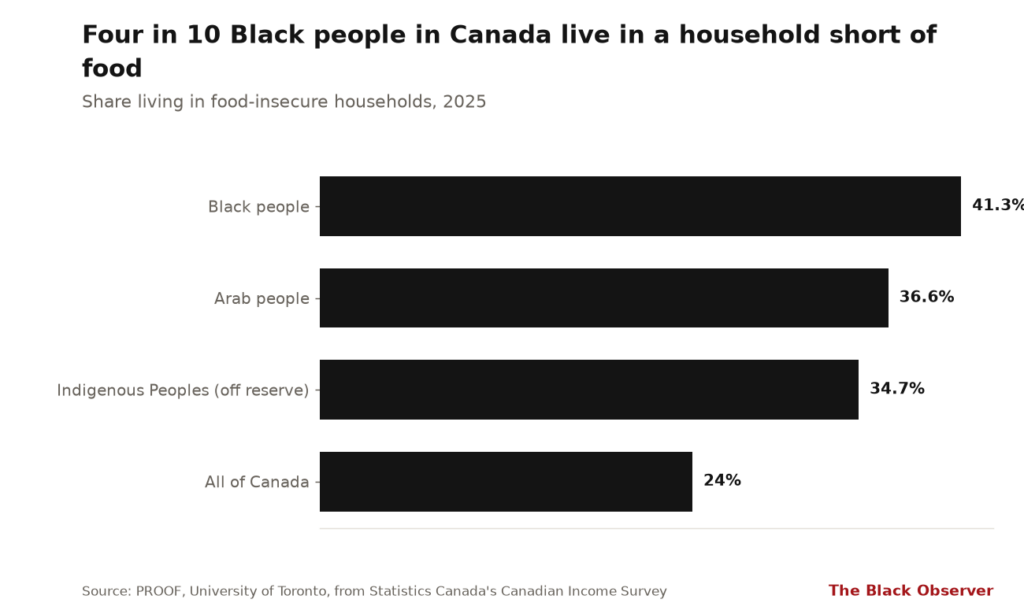
In 2025, 41.3% of Black people in Canada lived in a household that could not reliably afford enough food. That is the highest rate of any group the country’s income survey breaks out, and it is close to double the 21.0% for people who are not racialized, according to Statistics Canada’s own figures.
The Black figure comes from PROOF, the University of Toronto research group that analyses Statistics Canada’s Canadian Income Survey. Its summary puts it plainly: “Food insecurity is racialized.” Arab people were next at 36.6%, then Indigenous Peoples living off reserve at 34.7%. Nationally the rate was 24.0%, about 9.8 million people, including 2.4 million children.
Statistics Canada’s release of the survey does not publish a Black rate in its text. It reports the broader gap: “Among racialized groups, the food insecurity rate was 30.4% in 2024, compared with 21.0% for those not in a racialized group.” The Black rate sits well above both. The survey’s income figures are for 2024, and the food questions were asked between January and July 2025.
Poverty explains part of it, not all
Food insecurity means a household worries about running out of food, cuts the quality or quantity it eats, or at the extreme goes without meals because money is short. It follows income closely. The same Statistics Canada release found that 16.4% of Black Canadians lived below the poverty line in 2024, against 8.9% of non-racialized people.
The food gap is far larger than the poverty gap. Black people are about twice as likely to be poor and nearly twice as likely to be food insecure, but the food rate of 41.3% is more than double Black Canadians’ poverty rate. Many households above the poverty line still cannot cover rent, transit and groceries at once. The survey measures the result, not the cause, and it cannot say how much comes from lower pay, hiring barriers, housing costs or the cost of supporting relatives elsewhere.
Children carry it too. Across the country, 30.8% of children under 18 lived in food-insecure households, and 78% of those children were in households that cut the quality or quantity of food or skipped meals. The survey does not publish that breakdown for Black children.
A smaller number, and still the highest
There is one piece of better news. A year earlier, PROOF’s analysis of the previous survey put the Black rate at 46.7%. The 2025 figure is more than five points lower. Statistics Canada reports that the national rate also eased, with about 360,000 fewer people in food-insecure households. A rate of 41.3% is still the worst of any group, and the drop moves Black people from nearly one in two to just over four in 10.
The data also hides as much as it shows. “Black people” in the survey covers African Nova Scotians whose families have been in Canada for centuries, Caribbean communities in Toronto and Montreal and recent arrivals from Africa. Those households face different housing markets, immigration rules and wage floors. The survey does not report them separately, and it does not cover people living on reserves. PROOF notes the Indigenous figures understate the problem for that reason.
Where Black households live also shapes the rate. Alberta, Manitoba and New Brunswick are among the provinces with the highest overall rates, and Quebec is among the lowest, at 18.0%. The survey does not say how Black households fare inside each province.
What the researchers ask for
The remedy PROOF points to is income, not charity. “All the research point to the need to provide lower-income non-senior households with more adequate and secure incomes,” it says, through improved social programs or new measures such as a basic income. Food banks, the response Canadians see most, do not change that number.
That is the judgment the figures support. Ottawa now has a survey that shows one in four people in the country short of food, and four in 10 Black people. A federal government that wants to close that gap has the evidence in hand, and the question for the next budget is whether it will put incomes behind it. One year of lower numbers is not a trend, and 41.3% is not a number to settle for.

Have your say