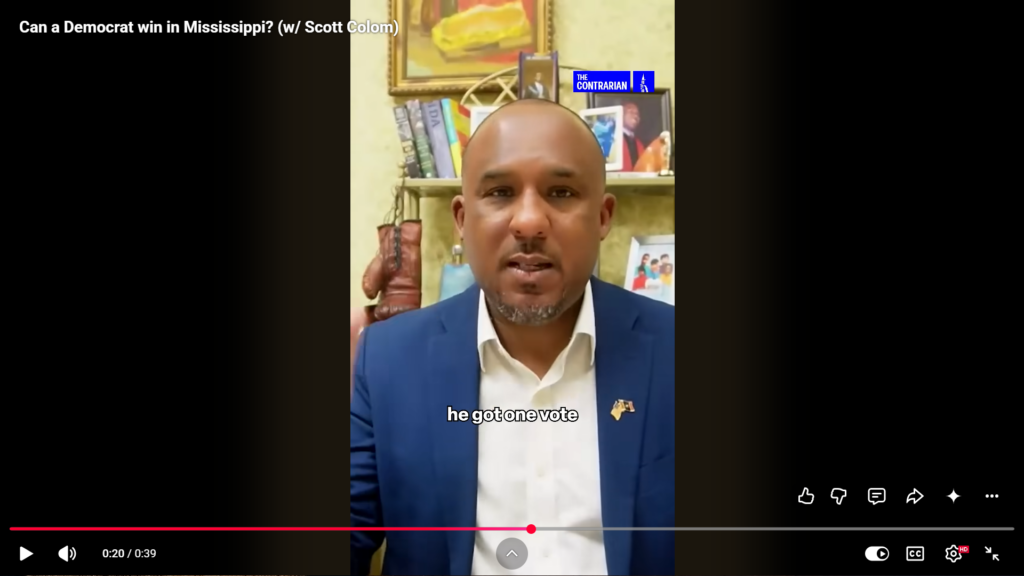
Scott Colom, a Black district attorney from Columbus, led Republican Sen. Cindy Hyde-Smith by 65 votes Wednesday morning in the closest Senate race in the country. With 95.6% of ballots counted, Colom had 462,857 votes to her 462,792. Both sit at 48.9%.
If the lead holds, Colom becomes the first Black person to represent Mississippi in the Senate since Blanche K. Bruce left office in 1881, and the first Democrat the state has sent since John C. Stennis, who won his last election in 1982. Mississippi is more than one-third Black, a larger share than any other state, and it has gone 145 years without a Black senator.
The count stalled overnight. Election officials paused with thousands of affidavit ballots still to be counted statewide, and outlets including the Mississippi Free Press reported about 9,000 outstanding in Hinds County, which includes Jackson. Independent Ty Pinkins took 19,938 votes, about 2.1%. Mississippi has no runoff for federal general elections, so whoever finishes first takes the seat.
Colom told reporters Wednesday: “Where we are, where the ballots are, we’re gonna win.” Hyde-Smith’s campaign answered: “We remain confident that when every legally cast vote is fully and accurately counted, Mississippians will have reelected Cindy Hyde-Smith.”
The two have a history. In 2023 Hyde-Smith used her senator’s veto power to block Colom’s nomination to a federal judgeship in northern Mississippi, a lifetime job. Had she let it go through, he would be on the bench today and not on the ballot. President Donald Trump campaigned for her. Former President Bill Clinton and former Vice President Kamala Harris campaigned for him.
Trump carried Mississippi by more than 20 points in 2024, and a poll earlier this fall had Hyde-Smith ahead by 6. A margin of 65 votes in a state like that did not come from nowhere. Black voters in Mississippi have had to fight for generations, against poll taxes, literacy tests and intimidation, for ballots that count in full.
That history is why the next few days matter as much as election night. Affidavit ballots are cast by voters whose eligibility a poll worker questioned. Each one should be checked against the law and counted if it is valid. In a margin this thin, no eligible voter should lose a ballot to a technicality, and county officials owe the public an open count.
Counties still have to finish the tally. Neither campaign had announced a recount request or a legal challenge by Wednesday morning, and a margin this small makes both possible.
Have your say