Black business owners are being told to shop local today, on Small Business Saturday. In Washington, the federal program that helped them win government contracts has been shrinking for a year.
The Small Business Administration (SBA) approved 65 new firms for its 8(a) Business Development Program in 2025, according to the agency’s own figures. During the four years of the Biden administration it accepted more than 2,200. The 8(a) program certifies firms owned by people deemed socially and economically disadvantaged and gives them counseling, training and a route into federal contracts. Under the rules still in force, Black Americans are presumed to be socially disadvantaged, which is why the program has mattered to Black-owned firms.
That presumption is now on the chopping block. In June, the SBA proposed a rule that would end race-based eligibility and require every applicant to show “verifiable, fact-based evidence” of social disadvantage. Firms owned by tribes, Alaska Native Corporations and Native Hawaiian Organizations would keep their current standard. The rule is proposed, not final.
The cuts came first. In February 2025 the agency lowered the federal government’s contracting goal for small disadvantaged businesses from 15% to the 5% that the law requires. In June 2025 it began the first audit of the 8(a) program in its nearly 50 years. In December it ordered all 4,300 or so participants to hand over three years of financial records. On Jan. 28 it suspended 1,091 firms, about a quarter of the program, for missing the Jan. 19 deadline. Months later it moved to terminate 628 of them.
The SBA’s account is that the program was being abused. Administrator Kelly Loeffler said in the January release: “The 8(a) Program was abused during the Biden Administration to benefit favored minority groups at the expense of every other legitimate small business owner.” The agency also pointed to $253 million in contracts tied to fraud allegations. Fraud, where it is proved, should be prosecuted. But the agency’s answer to alleged fraud by some firms was to freeze a fourth of the program, shrink the goal for everyone and close the door to nearly all newcomers.
The SBA has not said how many of the suspended or terminated firms are Black-owned, and its releases do not break the numbers down by race. That gap matters. A policy aimed at “favored minority groups” has been carried out without telling the public which groups lost.
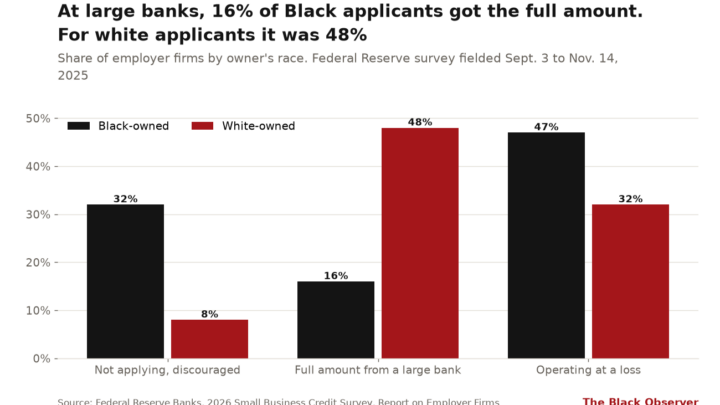
The squeeze lands on a sector that was already short of capital and now sees corporate diversity money drying up as well. Black entrepreneurs were told for years that government contracts were one of the few doors that stayed open. Federal buyers spend hundreds of billions of dollars a year, and a 5% goal for disadvantaged firms is a ceiling the agency has chosen to treat as a target.
Shopping at a Black-owned store today helps. It does not replace a contracting program. The SBA is taking comments on the rule, and Congress, which controls the 5% statutory floor, can decide whether the country still means to share its contracts with the businesses it says it wants to support.
Have your say