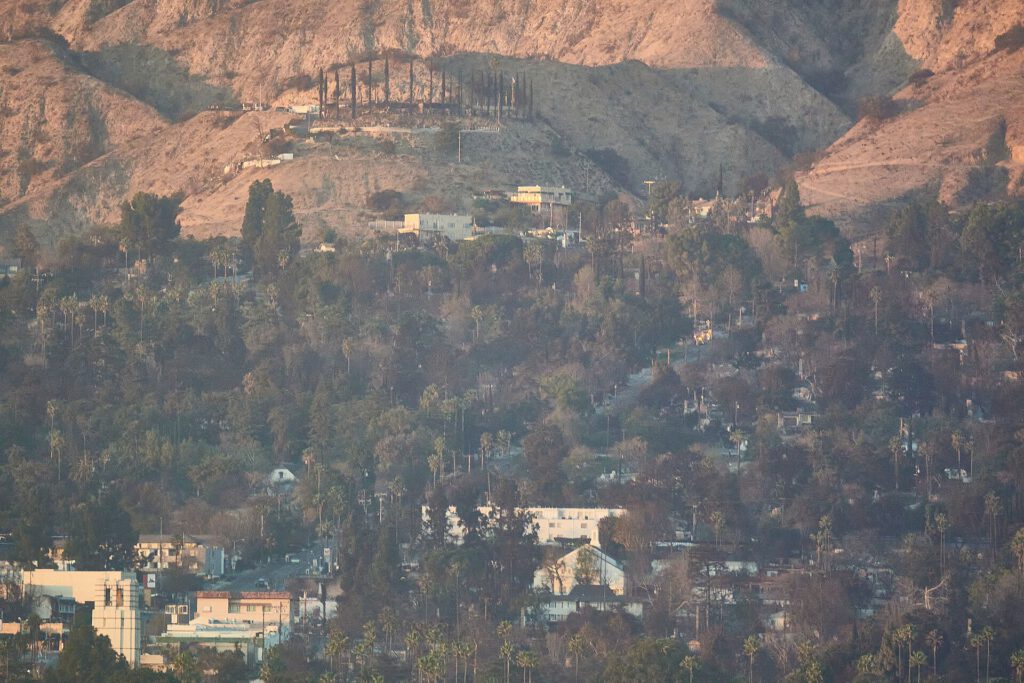
When the Eaton fire tore through Altadena in January 2025, the smoke that drifted across Los Angeles carried 50 times more lead than the smoke from an ordinary wildfire, a California Institute of Technology study published Wednesday in Science Advances found. At the peak of structural burning, the researchers estimate, about 7 million people breathed air with 24-hour lead concentrations 80 times above background levels.
Altadena is where the fire started and where Black Los Angeles County had one of its most solid footholds. An analysis by UCLA researchers found that 61% of Black households in the town sat inside the fire perimeter, against 50% of other households, and that 48% of Black households were destroyed or heavily damaged, against 37% of others. The same families who lost homes and belongings lived closest to what the study describes as an “urban smoke plume.”
The team, led by Caltech atmospheric chemists Haroula Baliaka and Nga Lee Ng, did not sample Altadena itself. They used continuous instruments at a monitoring station in Pico Rivera, about 11 miles south, from Jan. 8 to 12, 2025. Lead readings peaked on Jan. 8 and 9. Compared with smoke from 2024 wildfires, the urban plume was enriched about 50-fold in lead, 7-fold in chlorine and bromine, and 3-fold in arsenic.
Burning houses, cars, paint, electronics and furniture are the likely source. As the fire moved from Altadena’s streets into the Angeles National Forest, the potassium-to-lead ratio shifted from roughly 5 to 1 to 50 to 1 and then to hundreds to 1, the signature of a fire moving from structures to vegetation. The authors note the lead signature may reflect Altadena’s older housing stock.
“Smoke travels; it’s not just about the burn area,” Baliaka said. Ng said “wildfire smoke is very different fundamentally from the urban smoke.”
What is not known
Lead can stunt children’s development, lower IQ scores and raise blood pressure in adults. Arsenic is linked to several cancers. But the researchers say they do not yet know what a short, intense exposure does to health, and the study does not measure illness in any group. It also does not break down who breathed the plume by race.
For Altadena’s Black residents the exposure came on top of a financial blow. The town had nearly double the Black homeownership rate of the wider county, and UCLA’s analysis found more than half of Black homeowners were elderly, which leaves them more exposed to insurance shortfalls and scams. Redlining had concentrated Black families in the parts of Altadena that burned.
Earlier tests by Caltech and other teams found lead on indoor surfaces in homes outside the burn zone, including one home with levels 150 times the Environmental Protection Agency’s limit, and researchers from UCLA and UC Davis reported airborne chromium-6 near cleanup sites months after the fire.
Co-author Yaguang Wei said the findings carry “important policy implications.” The authors call for better monitoring of urban fires as they grow more frequent.
Have your say