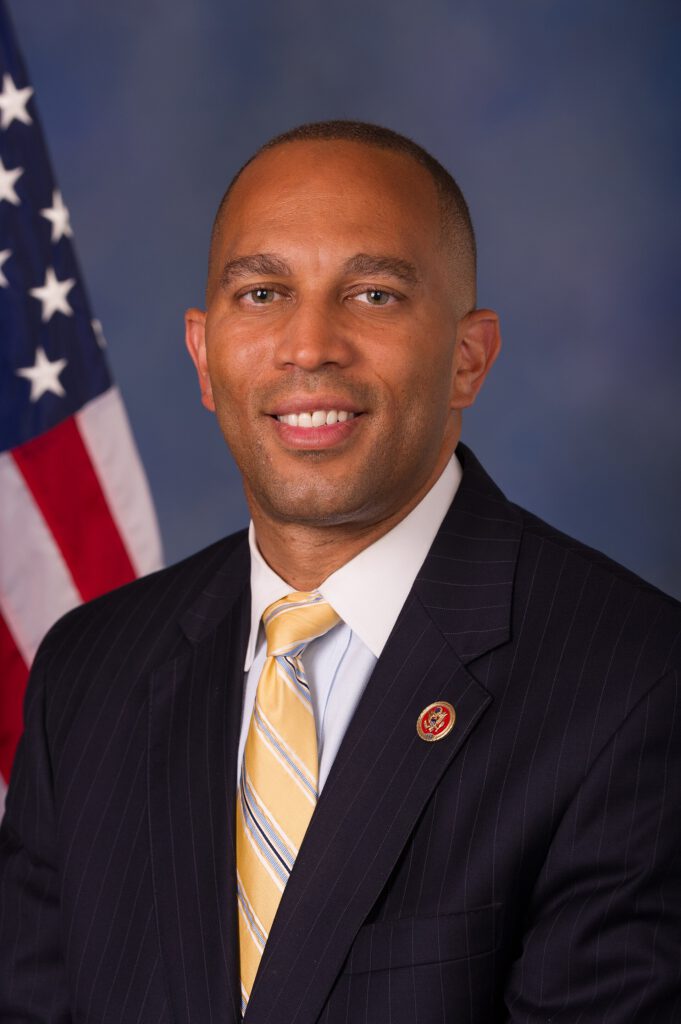
No Black lawmaker has ever held the gavel in the U.S. House of Representatives. In January, Hakeem Jeffries is set to be the first, after Democrats won back the chamber on Tuesday night.
Jeffries, 56, of Brooklyn, has led House Democrats since 2023. He would take the speakership more than 150 years after Joseph Rainey of South Carolina became the first Black member of the House, during Reconstruction. Black voters did a great deal of the work: they turned out in the South under maps drawn to dilute their votes, and they helped elect Keisha Lance Bottoms as Georgia’s governor, the first Black woman ever elected governor of a state.
“America is back,” Jeffries told supporters at his election night headquarters. “The American people have spoken and made clear they’ve had enough of the extremism, enough of the corruption,” he said at a press conference. “We’re going to fight to make sure that we make this country affordable for every single American,” he said.
The final seat count was still being tallied Wednesday morning. Projections had Democrats at 235 seats or more in the 435-seat chamber. The formal vote for speaker comes when the new Congress is seated in January, and Jeffries needs a majority of the full House, so the margin of the Democratic caucus matters.
What the majority is for is already spelled out. House Democrats plan to use subpoena power starting in January to investigate President Donald Trump’s business dealings, immigration enforcement, pardons and construction projects in Washington, with Rep. Robert Garcia leading Oversight and Rep. Jamie Raskin leading Judiciary, CBS News reported. Their legislative priorities include reversing Medicaid cuts, extending the health insurance premium tax credits, and rolling back tariffs.
Those are Black issues before they are anything else. Black Americans are more likely than white Americans to be uninsured, and our own reporting this month found insurers asking for 15% more on ACA plans for 2027. Medicaid cuts land first on the families who rely on it. Immigration enforcement has reached Haitian families in Springfield, Ohio, and Black immigrants across the country.
Trump congratulated Democrats and said: “I think they’re gonna want to work with me. Otherwise I’d just veto everything.” That is the real limit on this majority. A Democratic House can investigate and hold hearings, but it cannot make a president sign anything.
That is why the promise matters more than the milestone. A first is a first, and Black voters earned this one. But they did not turn out in record numbers to see a portrait unveiled. They turned out for lower premiums, for protection from the agents at their door, and for a Congress that asks questions of the people in power. Jeffries owes them hearings that start in January, and a fight over health care that starts the same week.
Have your say