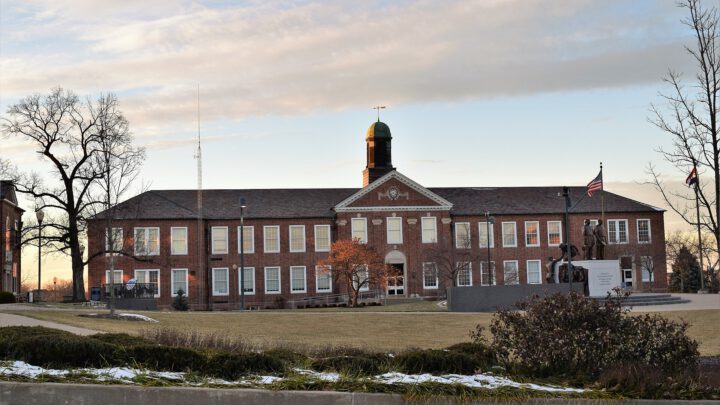
Taki Allen was 16, standing outside Kenwood High School in Baltimore County, Maryland, waiting for a ride home from football practice with a bag of chips in his hand. Minutes later he was on the ground in handcuffs. Three school officials had already decided he was holding no weapon.
Allen and three teammates, Yui-Osa Ogbeide, Devon Thompson Jr. and Keith Winfield III, have sued Baltimore County Public Schools, the Baltimore County Police Department and Omnilert, the company that makes the AI gun-detection system the district uses. The four are Black. They say they were held, handcuffed and searched on Oct. 20, 2025, with no justification, and that no one has publicly apologized.
According to the 31-page complaint, Omnilert’s software flagged Allen’s bag of Doritos as a firearm. Three officials canceled the alert. The complaint says Principal Catherine Smith “never acknowledged the Alert’s cancelation,” and instead texted a screenshot of Allen holding the bag to the school resource officer, who passed it to police. Within 16 minutes, it says, six police cruisers arrived, many with officers’ guns drawn. The students were forced to the ground, handcuffed and searched. No weapon was found.
The complaint says officers then acknowledged the mistake. One reportedly said, “AI is not the best.” Another muttered about “stupid AI cameras.” Smith later wrote to staff, in a message the lawsuit says “made light of the incident”: “No worries. SRO had patrol car roll through. It was a bag of chips,” followed by crying-laughing emojis.
Attorneys from the Lawyers’ Committee for Civil Rights Under Law, the Engel Law Firm and Willkie Farr & Gallagher filed the suit in Baltimore County Circuit Court. It claims unreasonable search and seizure, false arrest and imprisonment, and negligence. The students ask for better training, clearer communication between schools and police, safety guardrails for Omnilert and a pause on using the system.
Race is part of the claim. “We can’t ignore the potential consequences of an armed police encounter, especially with young Black men,” said Freya Jamison, an attorney with the Lawyers’ Committee. Lon Engel, the students’ lawyer, asked why none of the other officers on scene told the responders it was a bag of chips, and said “young black men are viewed in a fashion different.”
The defendants are not conceding that. Omnilert says the system worked as designed: it flags possible threats for human review, and school staff canceled this one properly. The county and the school district declined to comment on pending litigation. Maryland’s inspector general of education, Richard Henry, attributed the incident to “human error,” citing low light and the position of the student’s hand near the bag.
That finding cuts against the district too. If a machine’s mistake was caught by people within two minutes, what happened over the next sixteen was also decided by people. A school can buy software that is sometimes wrong. It cannot treat Black teenagers as armed because a screenshot says so after its own staff said otherwise. The complaint adds that the same system failed to detect a shooter at Antioch High School in Nashville in January 2025, where two students died.
Baltimore County owes these four young men an apology, a rule that stops a canceled alert from ever reaching an officer, and an answer on why its principal was joking about it. The case now moves through the county circuit court.

Have your say