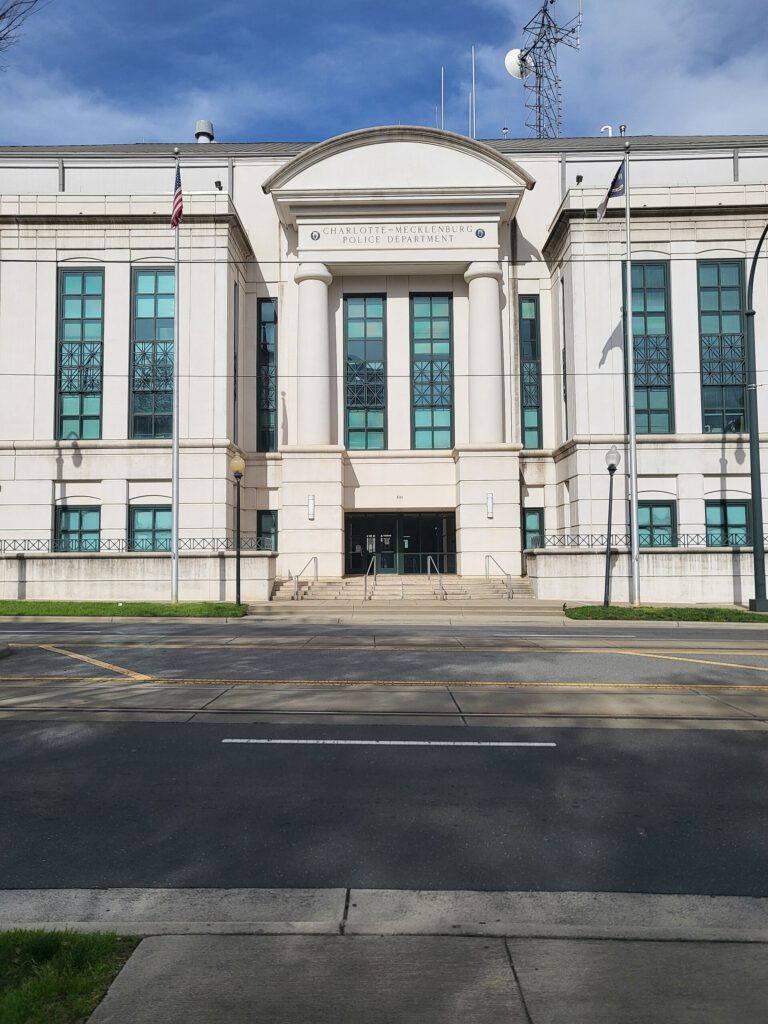
In a group chat, Charlotte police officers competed to see who could pull over the most Black drivers. They used the N-word, and they talked about force and firearms in the same thread. On Tuesday, Election Day, those officers’ department patrols the streets where Black Charlotteans go to vote.
The Charlotte-Mecklenburg Police Department (CMPD) has named seven officers tied to the texts, which date back years. Chief Estella Patterson recommended that six be fired and said she hoped they would “lose their jobs and never work in law enforcement again.” Five have resigned. Jeremiah Todman remained suspended without pay as of Oct. 19, waiting on the city’s Civil Service Board, which has the final say because the chief cannot fire sworn officers on her own.
The messages came to light by accident. The State Bureau of Investigation was looking into former officer Seth Elliott over alleged misuse of Flock license-plate cameras and pulled the texts from his phone, as WBTV first reported. Patterson called it “especially painful and disheartening to hear concerns from our community about racism coming from within the ranks.”
The numbers were already there
The texts describe a game. The department’s own stops suggest it was not only a game. NC CopWatch, which tracks 2025 data, found Black residents are 33.7% of Charlotte’s population but 53.5% of traffic stops, 80.9% of searches and 88.9% of use-of-force incidents.
Those figures cover the whole department, not these six officers, and they do not prove what any single officer did. They do show who bears the cost when a police force treats stops as a contest. Defense attorneys have said the messages could raise credibility questions in any case these officers touched, which means every conviction built on their word is now open to challenge.
Charlotte’s Black residents also face a second pressure this week. Forward Justice, a North Carolina legal group, told NewsOne that nearly a third of the calls it has received from voters and volunteers involved police or law enforcement presence at or near polling places across the state. Police are allowed on public streets, and a report is not a finding of intimidation. But in a city whose own officers swapped slurs about Black drivers, a squad car outside a polling place is not a neutral sight.
Charlotte’s Black voters know the history. Police were used to keep their grandparents from the ballot box, and the department has now shown, in its own officers’ words, how some of its members saw them.
The Civil Service Board has not yet ruled on the officer still suspended. CMPD says it is reviewing body camera footage, officer communications and its hiring practices. Polls in North Carolina close at 7:30 p.m.
Have your say