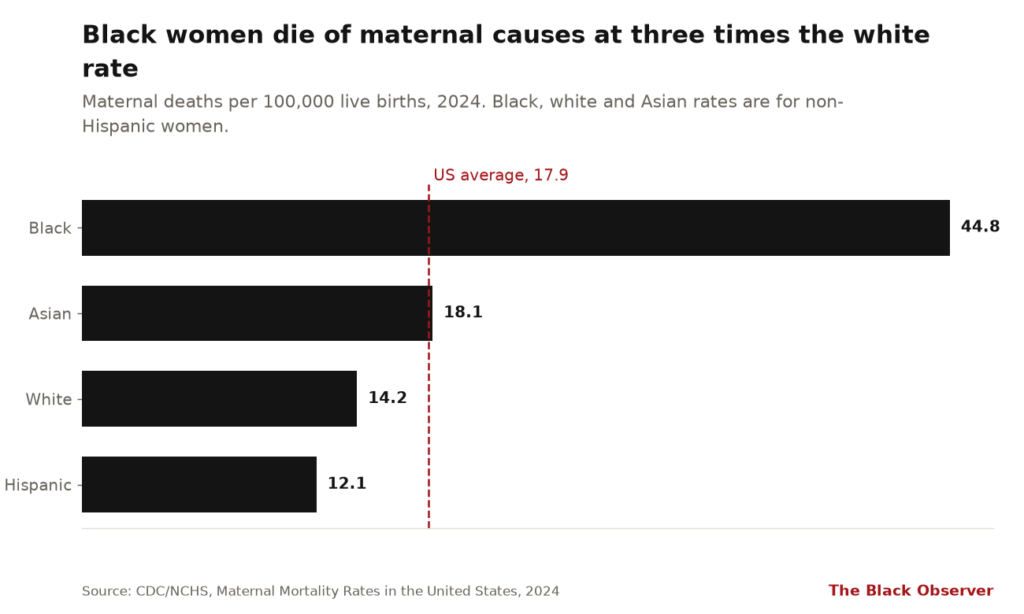
Black women died of maternal causes at 44.8 per 100,000 live births in 2024, against 14.2 for white women, 12.1 for Hispanic women and 18.1 for Asian women. The national figure was 17.9, from 649 maternal deaths. The rate for Black women is roughly three times the white rate, which is where it has been sitting.
The figures come from Maternal Mortality Rates in the United States, 2024, the health statistics report the National Center for Health Statistics published in March. It is worth being precise about what the report says changed, because the answer is close to nothing.
A decline that is not a decline
The national rate went from 18.6 in 2023 to 17.9 in 2024. NCHS states that this is not a significant decline. The same applies to the movement within each group: the observed decreases for Black, white and Hispanic women and the observed increase for Asian women were all inside the range you would expect from year-to-year variation in a count this size.
That distinction gets lost quickly. A rate that drops seven tenths of a point reads as progress, and 649 deaths is a small enough number that a handful either way shifts the rate without meaning anything. The honest summary of 2024 is that the national rate held, and the gap held with it.
Age compounds the picture. Women 40 and older had a maternal mortality rate of 62.3, nearly five times the 13.7 rate for women under 25. Age and race are not independent of each other in the data, and the report does not publish a breakdown that crosses them, so the rate for older Black women is not something that can be read off the table.
What the count leaves out
There is a definitional limit here that matters more than it sounds. The National Vital Statistics System counts a death as maternal if it occurs during pregnancy or within 42 days of its end. Deaths after that window are not in the 17.9 or the 44.8.
The Policy Center for Maternal Mental Health has pointed out what that excludes: deaths from suicide and from overdose, which cluster later in the postpartum year rather than in the first six weeks. State maternal mortality review committees, which look at a full year after birth and read the case files rather than the death certificates, consistently find higher numbers and a different mix of causes than the vital statistics system does.
So 44.8 is not the ceiling for Black women. It is the figure for deaths close enough to delivery to be captured by a death certificate code.
Why the gap is not a medical fact
The most common misreading of a figure like 44.8 is that it describes something about Black women’s bodies. It describes something about what happens around them. Research on maternal deaths has repeatedly found that Black patients’ reports of pain and of symptoms are discounted, that the hospitals serving Black neighbourhoods are the ones with thinner staffing and fewer intensive care beds, and that insurance status and distance to a hospital with an obstetric unit both track the same lines.
The policy consequence is specific rather than general. Most of what state review committees classify as preventable is preventable by a person who is in the room: recognising a haemorrhage, reading a blood pressure, taking a patient’s account of her own symptoms at face value. That is a staffing and training question, and it is answerable with money.
Medicaid pays for about four in ten births in the country and a larger share of births to Black mothers, which makes the postpartum coverage window the single clearest lever any legislature has. Coverage that ends before the deaths do is a design choice.
NCHS publishes these figures once a year, so the 2025 data is a year away. Between now and then the numbers that will move first are the state ones, and the state review committees are the bodies that see the cases the death certificates miss.
One caution on reading any single year of this series: the 2021 peak and the drop that followed it were largely a covid artefact, and comparisons that start there will overstate improvement. Against 2019, the national rate is still higher, and the ratio between the Black and white rates is approximately where it was.
The next federal release is due in 2027.




Have your say