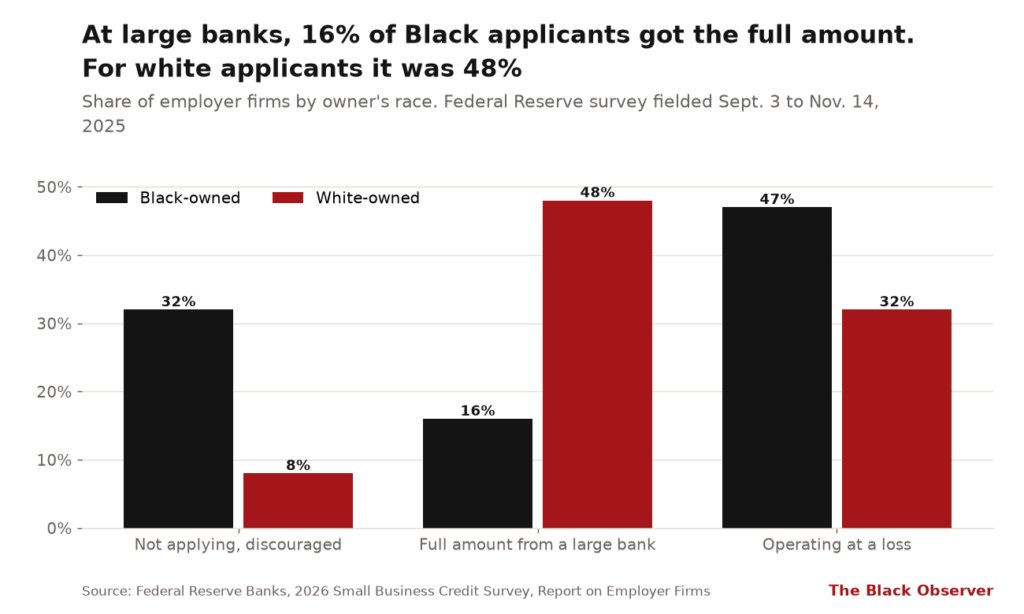
Ask a large bank for a business loan and 48% of white applicants get the full amount. Among Black applicants, 16% do. Nearly half of Black applicants at large banks, 48%, walk away with nothing.
Those are the figures in the Federal Reserve Banks’ 2026 Small Business Credit Survey, published in March, and they land on Small Business Saturday, the day the country is told to spend its money at the shop down the street. For Black owners, the shop down the street is often the firm that could not borrow what it needed.
The survey was fielded from Sept. 3 to Nov. 14, 2025, and drew 6,525 responses from a nationwide convenience sample of small employer firms, those with 1 to 499 employees. Because it is a convenience sample rather than a random one, its numbers describe the firms that answered, not every business in the country. The pattern is still hard to read as anything but a pattern.
Who is in the survey, and how they are doing
Black-owned firms made up 3.4% of employer businesses in the data, about 201,000 firms with $249 billion in receipts. These are the businesses with payrolls, the ones that hire neighbors.
Of those firms, 47% reported operating at a loss. For white-owned firms the figure was 32%. The Fed also found that between 67% and 77% of minority-owned firms rated their financial condition as poor or fair, against 51% of white-owned firms.
A business that loses money needs credit most. That is where the gap opens. At large banks, which supply the biggest loans, the full-approval rate for Black applicants was one third of the white rate. Nearly half got a flat no.
The ones who never applied
The refusals understate the problem, because many owners do not ask. Among firms that chose not to apply for financing, 32% of Black-owned firms said they were discouraged, meaning they expected to be turned down. For white-owned firms the share was 8%, a four to one difference.
That discouragement is learned. A Black owner who has watched peers get denied, or who has been denied before, makes a rational calculation about whether the application is worth the fee and the hit to a credit file. The cost of that calculation never shows up in a denial rate.
When Black-owned firms were turned down, 55% of them cited a low credit score as the reason, the most common explanation, ahead of collateral, debt levels or weak sales. A credit score is not neutral. It is built from a history of mortgages, cards and loans, and that history was shaped by redlined maps and by decades of Black families being steered into worse credit products. A lender can follow its own rules to the letter and still reproduce the gap.
What lenders will say, and the answer
Banks point to risk. A firm that loses money is a riskier borrower, and the survey does show Black-owned firms in worse financial shape. That is a fact, and it belongs in the story.
It does not close the argument. The survey cannot say how much of the gap in losses comes from the gap in capital: a firm that cannot borrow for inventory, equipment or a second location stays small and fragile. Risk that lending itself helps create cannot be fully blamed on the borrower.
The survey does not show what any single lender decided or why, and it does not claim to. It reports what owners say happened to them. Among large banks, the ones with the most money to lend, that was a full yes for 16% of Black applicants.
What would change it
The fixes are known. Federal rules that require lenders to collect and report small-business lending data by race would let regulators and the public see which banks lend and which do not. Community development lenders and Black-owned banks, which are small, cannot cover the gap alone. Large banks that take deposits from Black neighborhoods should be asked to lend there on terms they offer elsewhere.
None of that happens by being told to shop small. A Black owner who needs $100,000 and is offered nothing cannot be helped by a hashtag.
Have your say