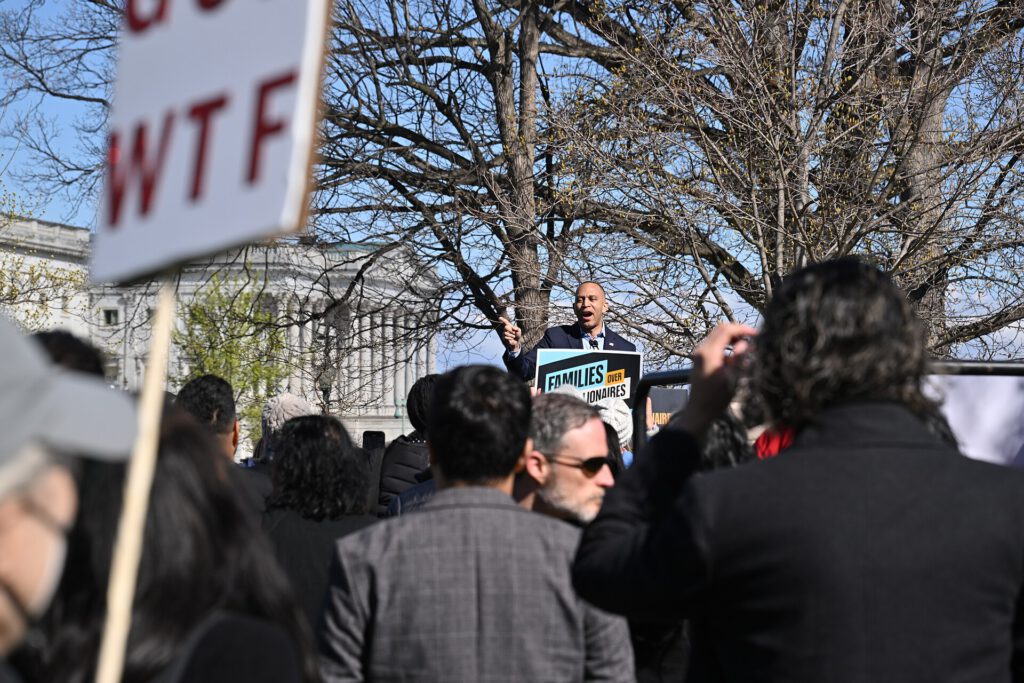
House Democrats nominated Hakeem Jeffries for speaker on Nov. 18 by a vote of 251 to 11. If the full House confirms him on Jan. 3, he becomes the first Black speaker in its 237-year history.
The 11 who voted no included seven freshmen members-elect who put out a joint statement. They are Darializa Avila Chevalier, Adam Hamawy, Frederick D. Haynes III, Melat Kiros, Donavan McKinney, Chris Rabb and Claire Valdez. They said they had asked Jeffries for commitments on four issues: Medicare for All, stopping immigration enforcement operations, campaign finance reform and ending military support for Israel’s war in Gaza. “Our constituents sent us to Congress with a mandate on these issues,” they wrote. They also said conversations with leadership are “ongoing” and that there has been “meaningful progress.”
Reporting differs on whether all seven cast a ballot: Fox News reported that Haynes was absent because of illness. The statement itself is not in dispute.
Jeffries answered without naming anyone. “It’s an honor to be serving with a majority of 260 members from all across the country, people who have different perspectives, and we embrace that,” he said. “But we’re going to work together to find the highest common denominator in order to make life better for the American people.”
The arithmetic is on his side. He needs 218 votes on the floor, and Democrats are projected to hold 259 seats, their largest majority since 1990. Eleven defections do not threaten the gavel. What the vote shows is where the leverage sits.
That majority was built in part by Black voters, including in the districts Republicans redrew, and the four demands are not abstract to them. Medicare for All and an end to ICE raids are fights over who gets care and who gets stopped, and Black families are on the wrong end of both. Kiros, who won in Denver at 29, is herself part of the largest class of new Black Democrats Congress has seen since 1993.
The paper’s view is that both things are true. A first Black speaker is a milestone that Black readers waited 237 years for, and it deserves to be celebrated as one. A speaker with the biggest House majority in 36 years also owes the voters who delivered it a plan on health care and immigration, not a promise to find the “highest common denominator.” The freshmen are right to ask for dates and bill numbers.
The full House votes Jan. 3. The seven say the talks are still going.

Have your say