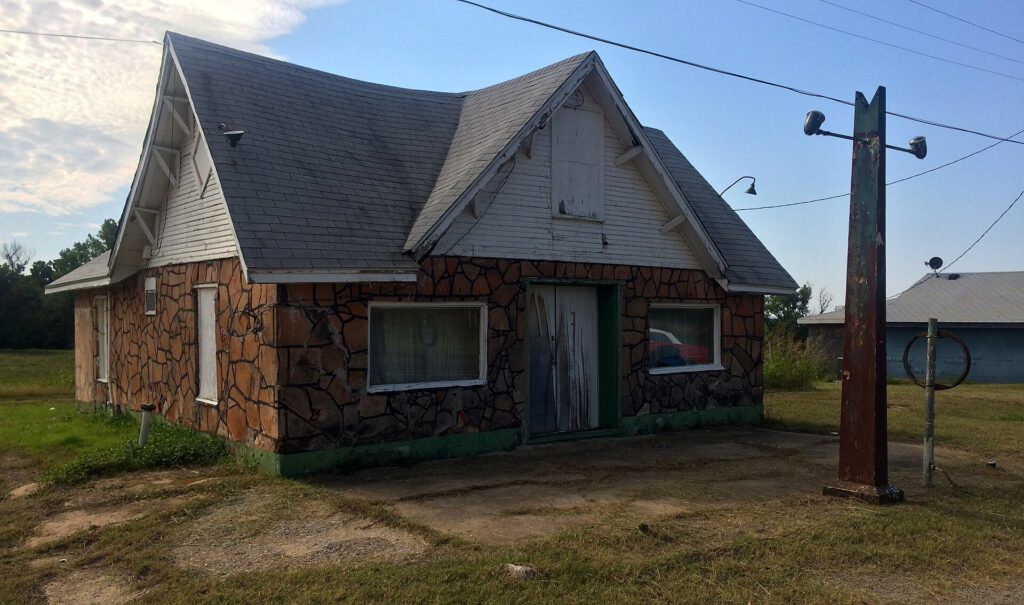
For Black families driving Route 66 in the Jim Crow era, most gas stations were places to be refused. Outside Luther, Oklahoma, one was not. The Threatt Filling Station, the only known Black-owned and operated station on the highway, has reopened after decades closed, NPR reports, and the people who did it are the founder’s grandchildren.
Allen Threatt Sr. built the first station in 1915. He had come to Luther from Alabama in the early 1900s, during the Great Migration, and he noticed cars passing a corner of his land on what was then the Ozark Trail. When Route 66 opened in 1926, the trickle became a steady stream. The original building burned, and the family rebuilt it in the 1930s. The National Trust for Historic Preservation dates the current structure to a cornerstone marked March 22, 1933.
Black travelers then planned trips around the Green Book, the guide to the places that would serve them, because most restaurants, motels and stations would not. Between sundown towns, where Black people were not safe after dark, the Threatt station sold fuel and gave more than that.
“If they didn’t have any food, they fed them,” Linda Fisher, the founder’s granddaughter, said in NPR’s report. “If they needed some kind of shelter or blankets or those types of things, Grandpa and Grandma made sure they got those kinds of things.” Edward Threatt, another grandchild and a former mayor of Luther, told KGOU: “Back in the Jim Crow era, it was very important that people knew that they had a place that they could come, they could stop, and they could be safe.”
The property was also a gathering place, with dances, social club meetings, barbecues and, occasionally, Negro Leagues baseball games. The family ran the station for decades. Elizabeth Hilton Threatt managed it from 1956 to 1974, and she integrated Central State College, now the University of Central Oklahoma, as one of five Black students admitted. The Luther public library carries her name. The station closed to the public in the 1970s and was listed on the National Register of Historic Places in 1995.
Then the building sat. In 2021 the National Trust named it one of America’s 11 Most Endangered Historic Places, and it later received support from the trust’s African American Cultural Heritage Action Fund. Three grandchildren, David Threatt, Edward Threatt and Fisher, led the restoration through a family foundation, and the Oklahoma Department of Commerce announced a Route 66 revitalization grant for the site in October 2024. The exterior has been restored. A blue building next door is slated to become a restaurant, and the family has talked of an RV park and a new ballfield.
The reopening lands in Route 66’s centennial year, when the highway’s story is being retold as chrome, milkshakes and Cadillacs. Black travelers were on that road too, and they were routinely denied the pump, the counter and the room. It took a family, a handful of grants and years of work to keep the one place that welcomed them from falling down. Public money and heritage funders should not wait for the next crumbling building to be named endangered before they pay for the places where Black history happened.

Have your say