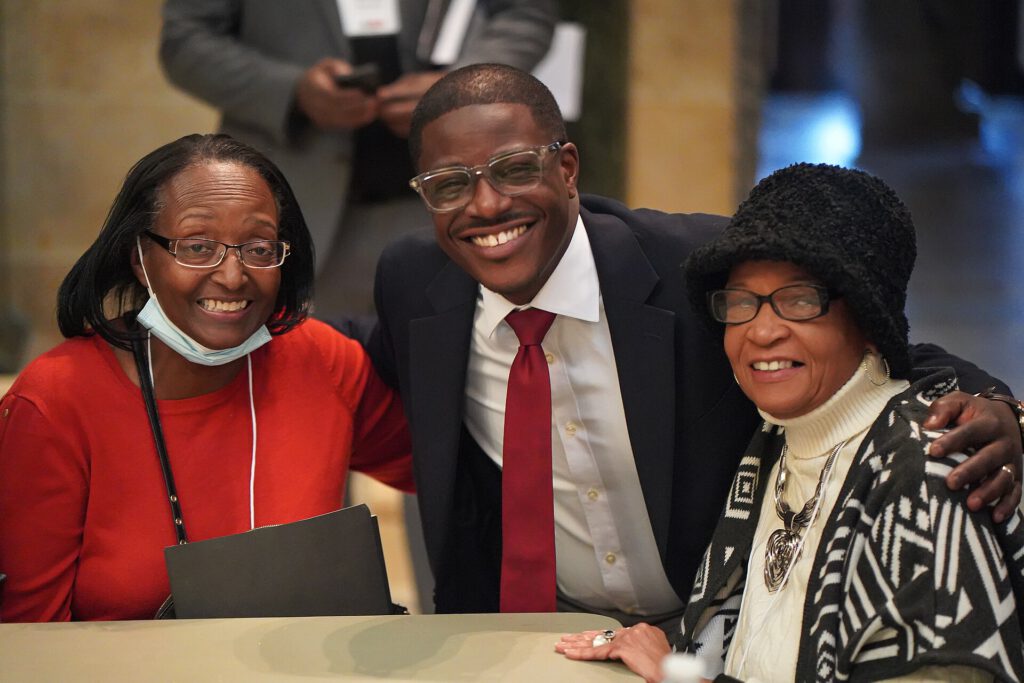
Wisconsin’s governor commuted 14 prison sentences on Nov. 13, the first time anyone in that office has done so since 1995. In a state that imprisons Black residents at 12 times the rate of white residents, the process now passes to David Crowley, who will be its first Black governor, and he has already said where he will draw a line.
The 12-to-1 gap is from 2022, in a Wisconsin Policy Forum report, and it is the second-highest in the country, behind only Vermont. More than two-thirds of Black Wisconsinites live in Milwaukee, and the report points to the state’s racial segregation and income gaps among the factors behind the disparity. The state’s prison population hit a record 23,900 adults this year, according to Wisconsin Public Radio, even as Gov. Tony Evers had set a goal of reducing it.
Evers granted the 14 commutations on the recommendation of a Commutation Advisory Board that he revived. He denied 10 other applicants who had hearings. The people who got relief were convicted of crimes from burglary to armed robbery to first-degree intentional homicide. Michael Maldonado was 15 when he was convicted of homicide in 1995; his life sentence was cut so that he is eligible for parole after at most four more years. Most recipients are not walking out: some must serve more time before they can be considered for parole. The reports do not give a racial breakdown of the 14.
Not everyone welcomed it. Calumet County District Attorney Nathan Haberman objected to the commutation of Sammy Cole, saying that “further review and second guessing by a less informed Commutation Advisory Board is not necessary nor appropriate.” Shannon Ross, CEO of the nonprofit The Community, said of those who got relief: “It’s a great thing for them and their families that there’s daylight now in a place that had no daylight.”
The board met again on Friday to hear another round of applicants, with more hearings set for Dec. 11. Evers has said he intends to approve or deny every applicant who has had a hearing before he leaves office in January. Twenty-three cases were still awaiting a decision after the first batch.
Crowley told the Milwaukee Courier on Nov. 16: “I commend the governor on bringing commutations back.” He has said he would work with lawmakers to make the process permanent, as Wisconsin Watch reported, but that he would not allow commutations of people convicted of murder.
That carve-out matters here. Evers’s own first list included a man convicted of first-degree intentional homicide as a teenager. A rule that bars every murder conviction would have shut out that case, and it would fall hardest in a state where Black people are imprisoned at a rate no other state exceeds by much. Making the process permanent is the right goal. A blanket exclusion by offense label, instead of a hard look at who the person is now, would empty it of much of its use.
Crowley takes office in January. The first test of what he means comes with whatever cases Evers leaves undecided.
Have your say