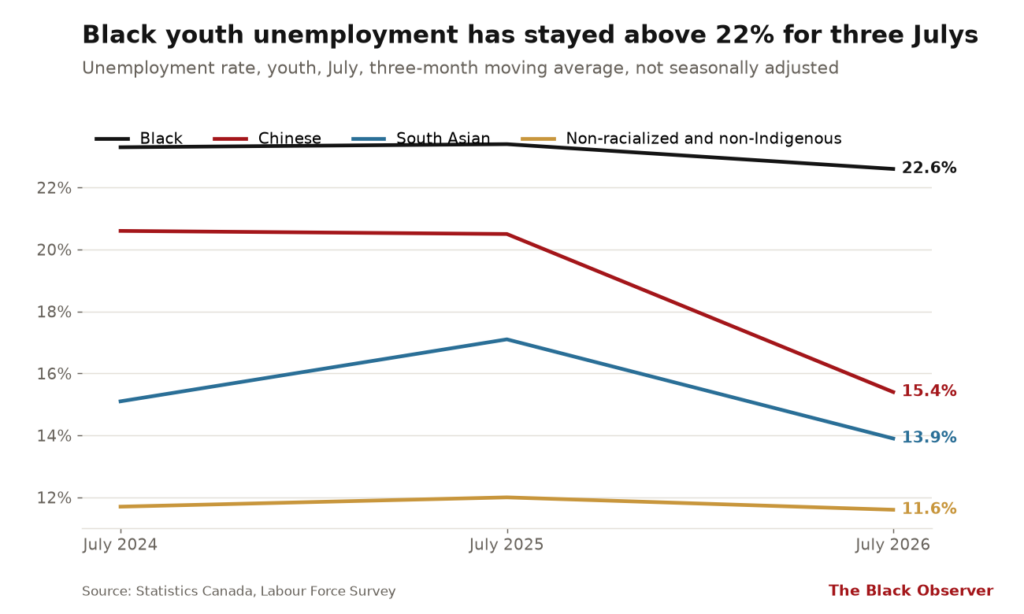
Canada’s youth unemployment rate rose to 13.7% in October, Statistics Canada said Friday. For Black young people the rate was already far above that this summer: 22.6% in July, the highest of any major racialized group, and almost exactly where it stood in 2024.
The comparison is in the agency’s own youth labour chart. In July, 11.6% of non-racialized and non-Indigenous youth were unemployed. For Black youth the figure was 22.6%, nearly double. Those are three-month moving averages, not seasonally adjusted.
The more telling number is the direction. Between July 2025 and July 2026, Chinese Canadian youth unemployment fell from 20.5% to 15.4%, and South Asian youth from 17.1% to 13.9%. Black youth went from 23.4% to 22.6%. Over three Julys the rate has run 23.3%, 23.4% and 22.6%. When the market improved for others, it did not reach them.
The October release itself carries no breakdown by race. Overall, employment was flat at 21.1 million, the unemployment rate rose 0.2 points to 6.7%, and the youth rate climbed 0.7 points. The race figures above are the latest Statistics Canada has published, so the October picture for Black youth is not yet known. The monthly release leaves the race figures out.
The gap is not about effort or schooling. Statistics Canada’s study of Black labour market outcomes found that in August 2025, 77.2% of Black Canadians aged 25 to 54 were employed, against 82.8% of the overall population in that age group, and that the Black population’s unemployment rate has been higher than the total population’s throughout 2020 to 2025. Black workers are 5.4% of the labour force, about 1.2 million people. The agency’s subgroup analysis separates Caribbean-born and African-born immigrants, Canadian-born Black workers and non-permanent residents, because they do not all face the same market. Black Canada is not one thing.
What it does show is that a young Black person looking for a first job in Canada has been twice as likely as a non-racialized peer to come up empty for three years running. That is a measured result, and it has not budged.
Ottawa’s response should start with the data itself: publish the Black youth rate every month, by province and by city, so that a gap this size cannot hide for a quarter. Employment equity enforcement and youth hiring programs that report results by race would show whether anything works. Until then, each jobs report will keep telling the country how many young people are out of work and leave one group’s number for later.
Until the agency says otherwise, the last number on record for Black youth is 22.6%.

Have your say