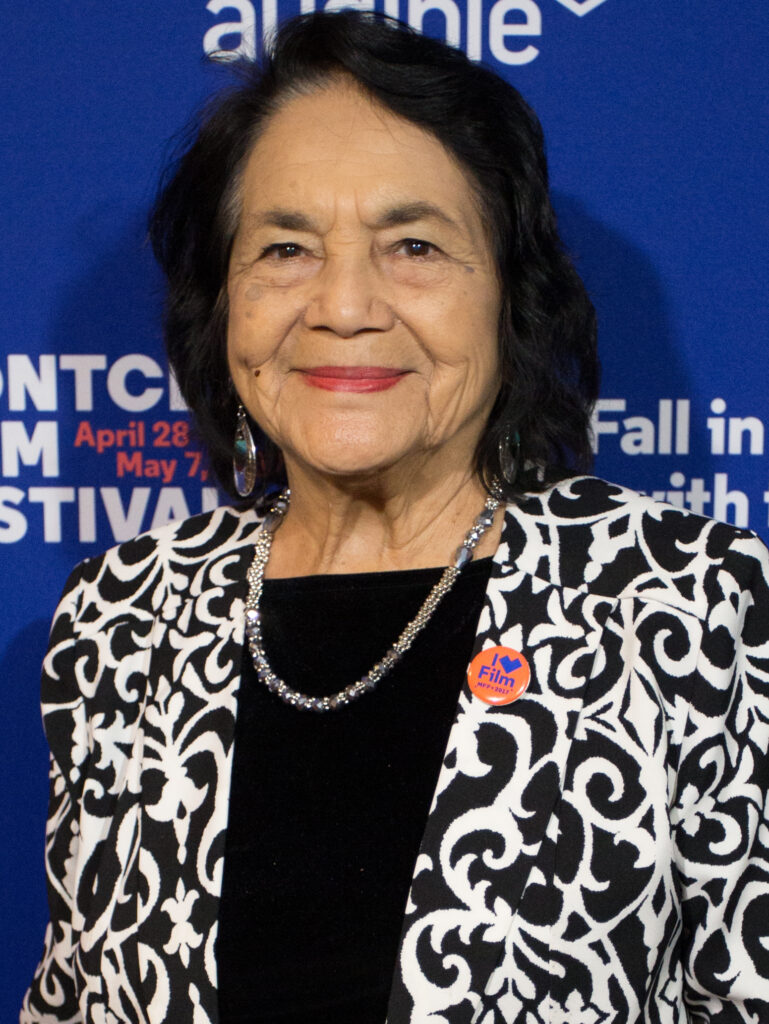
Dolores Huerta, the labor organizer who coined “Sí, se puede” and watched it become “Yes we can” in the first Black president’s campaign, died Wednesday at her home in Bakersfield, California. She was 96.
Her foundation announced her death and said she was surrounded by her close family.
Huerta began organizing in the 1950s, as the civil rights movement was taking shape under Martin Luther King Jr. In 1962 she co-founded the union that became the United Farm Workers with César Chávez, and she served as its vice president for nearly four decades. The phrase she came up with in 1965, during the grape strikes, was the one Barack Obama adopted for his 2008 run. In 2012, as president, he gave her the Presidential Medal of Freedom, the country’s highest civilian honor.
The slogan is the plainest line between her work and ours. A movement of Mexican American and Filipino farmworkers, mostly in California’s fields, wrote the words that a Black candidate later used to ask a country to believe a change was possible.
Her legislative record was concrete. As one of the few women lobbying in Sacramento in her era, she helped win driver’s license exams in Spanish, extend Aid to Families with Dependent Children to farmworker families, and bring disability insurance to agricultural workers, according to Time’s account of her career.
Huerta was born in New Mexico and raised in California’s San Joaquin Valley. She was a schoolteacher before she became an organizer. She had 11 children, four of them with Richard Chávez, César Chávez’s brother.
In March, she disclosed that César Chávez had sexually abused her in the 1960s, and that the abuse resulted in two pregnancies she kept secret. “I have kept this secret long enough. My silence ends here,” she said. Time named her to its 100 Most Influential People list this year.
She kept a full schedule into her 90s, marching in protests and speaking across the country for the Dolores Huerta Foundation, based in Bakersfield. Funeral arrangements have not been announced.
Have your say